Just to say, for anybody who still looks in on this barely-functioning blog ( and that's probably just you, John Pitt ) - I'm still here! The next scheduled but almost infinitely delayed post here will be about The Flaming Lips' psychedelic masterpiece The Soft Bulletin. One day. Definitely.
I was just thinking about all things cosmic after listening to Sarah's copy of the new Florence + The Machine album. I remarked that the last track, Mother, reminded me of the mighty Hawkwind. She asked me what Hawkwind sound like and I said "a swirling kind of song that goes on forever and sounds like a spaceship crashing." I think I nailed it!
BTW Hawkwind will probably never appear again on this blog :-)
Showing posts with label Rock. Show all posts
Sunday, 23 August 2015
Tuesday, 3 February 2015
Guest List
While the world waits with bated breath ( whatever that means ) for the next pulsating post on this absurdly inconsistent blog
( Album number 15, The Soft Bulletin ) I thought I'd share with you a favourite albums list from the mighty John Pitt. John has been a very generous supporter of my half-baked blogging efforts, both here and over at The Glass Walking-Stick, so it's a pleasure to present his rundown of Classic Rock, complete with liner notes. Take it away, Mr P...
The Beatles - the White Album
John Lennon - Imagine
Paul & Wings - Band On The Run
The Stones - Through The Past Darkly -( now I know this isn't a studio album, but a collection, but I chose this for nostalgic reasons )
The Who - Tommy
T. Rex - The Slider
David Bowie - Hunky Dory
Slade - Old, New,Borrowed & Blue
Queen - A Night At The Opera
Rod Stewart - Never A Dull Moment
Cream - Disraeli Gears
Led Zeppelin - II
Pink Floyd - The Wall -( I did have Hendrix's Are You Experienced, but someone beat me to it!)
Simon & Garfunkel - Bookends
Paul Weller - Stanley Road.
So there you have it - nowhere near as diverse a choice as yours, but, hey, I am an old-timer, after all!
( Album number 15, The Soft Bulletin ) I thought I'd share with you a favourite albums list from the mighty John Pitt. John has been a very generous supporter of my half-baked blogging efforts, both here and over at The Glass Walking-Stick, so it's a pleasure to present his rundown of Classic Rock, complete with liner notes. Take it away, Mr P...
The Beatles - the White Album
John Lennon - Imagine
Paul & Wings - Band On The Run
The Stones - Through The Past Darkly -( now I know this isn't a studio album, but a collection, but I chose this for nostalgic reasons )
The Who - Tommy
T. Rex - The Slider
David Bowie - Hunky Dory
Slade - Old, New,Borrowed & Blue
Queen - A Night At The Opera
Rod Stewart - Never A Dull Moment
Cream - Disraeli Gears
Led Zeppelin - II
Pink Floyd - The Wall -( I did have Hendrix's Are You Experienced, but someone beat me to it!)
Simon & Garfunkel - Bookends
Paul Weller - Stanley Road.
So there you have it - nowhere near as diverse a choice as yours, but, hey, I am an old-timer, after all!
I have to confess that I only own three of those albums myself
( Bowie, Zep and Floyd ) but I could certainly see myself parting with a few quid for a handful more - Band On The Run, Disraeli Gears and A Night At The Opera are all albums that I've always meant to buy but not actually got round to. Must try harder :-)
Thanks again to John for his list and if anyone else would like to comment on these albums or send me a list of their own faves please feel free to do so.
Sunday, 14 September 2014
Abbey Road by The Beatles
What is there left to say about The Beatles at this great remove, fifty years since their glory days? Probably not much of any consequence, truth be told. Luckily, I only deal in the inconsequential...
As ever, this isn't some scholarly investigation into the Fab Four's art - just me rambling on about a favourite album and what it means to me. And it does mean quite a lot...
For most of my life I've only owned one Beatles album: a vinyl copy of Sgt. Pepper that my parents gave to me for Christmas when I was a teenager. That album is, of course, a thing of beauty and I always meant to buy more Beatles records but for one reason or another ( mostly the constantly high prices of Fab Four product ) I never got round to it. Until a few years back I discovered a box set of four Beatles CDs - Rubber Soul, Revolver, Sgt. Pepper and Abbey Road - going for the strangely sensible price of a tenner. Of course, I snapped it up, devoured the contents, and soon Abbey Road became one of these 'ere 15 Albums. All four would be worthy of inclusion but Abbey Road just edges out Revolver as my absolute fave and was the first that sprung to mind when I compiled the list, so it had to make it into the blog. Them's the rules. Anyway, with this one, I think I'll just dive in and play it song by song...
Come Together
What a way to start an album! Lennon's mid-paced, oblique R'n'B groover with a contrastingly clear message for the radicalised, post-hippie times: "One thing I can tell you is you've got to be free". Everything literally comes together ( see what I did there? ) on this track - great vocal interplay from John and Paul, soulful electric piano from Billy Preston and some wonderful drum patterns from the sadly much-maligned Ringo.
Something
George Harrison's crying guitar sound heralds his most beautiful, heartfelt ballad. "All I have to do is think of her..." Smooth, easy listening maybe... but none the worse for that.
Maxwell's Silver Hammer
Paul McCartney's tasteless but guiltily funny tale of an unrepentant serial killer, presented as a children's song. Only The Beatles could get away with such whimsical nonsense. Just. Love the "do-do-doo" backing vocals!
Oh! Darling
Paul again, but this time with a far superior song: a pastiche '50s / doo-wop rocker, harking back to the band's early days. McCartney's voice is raw and ragged, tearing the final "do you no harm" from his battered larynx.
Octopus's Garden
Another kiddies' song. Ringo's charming but inconsequential sub-aqua ditty is a close relation of Yellow Submarine and passes the time amiably enough.
I Want You ( She's So Heavy )
A slow, strangely menacing and bluesy examination of lust, John patently singing about his obsession with Yoko. The final guitar riff repeats and repeats, clanging into itself again and again, the band's new toy - the Moog synthesiser - churns out white noise... and then...
Here Comes The Sun
...the sun comes out. Clearly one of the greatest songs in all of pop history. Optimism, love and good vibes - the epitome of The Beatles' philosophy. "And I say, it's alright..."
Because
And the sun keeps on shining! Because is a beautifully summery example of the boys taking a fairly simple song and transforming it with soaring, ethereal harmonies.
The "Long Medley" ( 8 songs edited and sequenced together )
Pretty much the dictionary definition of the whole being greater than the sum of its parts. The medley, constructed by McCartney, takes up most of Side Two of the original vinyl album and consists of various scraps of songs which the band had kicking around, sequenced into one fantastic collage. Perhaps realising that Abbey Road would be their final creative flourish ( Let It Be was their last album to be released but had been recorded previously ) The Beatles went out on a sky-scraping high.
It starts with the mournful piano notes of Paul's You Never Give Me Your Money, a sad reflection on the band's long and painful dissolution which turns into a hymn to freedom: "but oh, that magic feeling - nowhere to go", with some scorching lead guitar, before drifting into the Albatross-like Sun King, all lazy Mediterranean siestas and nonsense lyrics. A quick drum-beat and we're into two upbeat, rockin' Lennon songs about two eccentric characters, Mean Mr Mustard and Polythene Pam, complete with some very self-aware "yeah, yeah, yeahs" and nostalgia for the band's early years. With an "Oh, look out!" the medley shifts back towards Paul with his strange tale of a persistent Beatles fan - She Came In Through The Bathroom Window, a jangly, quintessential Fabs song with some perfect harmonies. Then it's the high point of the medley: Golden Slumbers / Carry That Weight, a staggeringly moving meditation on the band, the past, the future, with Olympian melodies and a red-blooded "boy, you're gonna carry that weight" from the full Fabs vocal ensemble. You Never Give me Your Money is reprised, this time with an orchestra in tow, before things get surprisingly funky and raucous as the guitarists duel it out for the last time. Finally, The End does exactly what it says on the tin and says goodbye to the band and the era with the sublime last line, "And in the end, the love you take is equal to the love you make..."
Her Majesty
Well, it's not exactly over as Paul's daft acoustic ditty surfaces 20 seconds after the end of The End to ensure we leave with smiles on our faces...
So, Abbey Road...It's all very wonderful and encapsulates everything the Beatles ( and all great pop music ) stood for: love, sex, fun, longing, freedom, mischief, melancholy - it's all here. And, of course, it all means different things to different people. On a very personal note, this album helped me immeasurably four years ago when my Mum was very ill. Things were as bad as they could get and then they got worse. The Beatles' wonderful music was there for support. The beautiful melodies, harmonies and awesome instrumental sounds were very resonant at this tough time and I took things from some of the lyrics that the writers surely never intended, but which gave me strength and spoke of love and history and peace. At the end of the day, music can be just music, a pleasant distraction, aural wallpaper, but sometimes... sometimes it's something more...
"Golden slumbers fill your eyes / Smiles awake you when you rise..."
( By the way... a special thanks goes out to new Follower John Pitt, whose recent comments inspired me to revive this 'ere blog. Cheers! )
As ever, this isn't some scholarly investigation into the Fab Four's art - just me rambling on about a favourite album and what it means to me. And it does mean quite a lot...
For most of my life I've only owned one Beatles album: a vinyl copy of Sgt. Pepper that my parents gave to me for Christmas when I was a teenager. That album is, of course, a thing of beauty and I always meant to buy more Beatles records but for one reason or another ( mostly the constantly high prices of Fab Four product ) I never got round to it. Until a few years back I discovered a box set of four Beatles CDs - Rubber Soul, Revolver, Sgt. Pepper and Abbey Road - going for the strangely sensible price of a tenner. Of course, I snapped it up, devoured the contents, and soon Abbey Road became one of these 'ere 15 Albums. All four would be worthy of inclusion but Abbey Road just edges out Revolver as my absolute fave and was the first that sprung to mind when I compiled the list, so it had to make it into the blog. Them's the rules. Anyway, with this one, I think I'll just dive in and play it song by song...
Come Together
What a way to start an album! Lennon's mid-paced, oblique R'n'B groover with a contrastingly clear message for the radicalised, post-hippie times: "One thing I can tell you is you've got to be free". Everything literally comes together ( see what I did there? ) on this track - great vocal interplay from John and Paul, soulful electric piano from Billy Preston and some wonderful drum patterns from the sadly much-maligned Ringo.
Something
George Harrison's crying guitar sound heralds his most beautiful, heartfelt ballad. "All I have to do is think of her..." Smooth, easy listening maybe... but none the worse for that.
Maxwell's Silver Hammer
Paul McCartney's tasteless but guiltily funny tale of an unrepentant serial killer, presented as a children's song. Only The Beatles could get away with such whimsical nonsense. Just. Love the "do-do-doo" backing vocals!
Oh! Darling
Paul again, but this time with a far superior song: a pastiche '50s / doo-wop rocker, harking back to the band's early days. McCartney's voice is raw and ragged, tearing the final "do you no harm" from his battered larynx.
Octopus's Garden
Another kiddies' song. Ringo's charming but inconsequential sub-aqua ditty is a close relation of Yellow Submarine and passes the time amiably enough.
I Want You ( She's So Heavy )
A slow, strangely menacing and bluesy examination of lust, John patently singing about his obsession with Yoko. The final guitar riff repeats and repeats, clanging into itself again and again, the band's new toy - the Moog synthesiser - churns out white noise... and then...
Here Comes The Sun
...the sun comes out. Clearly one of the greatest songs in all of pop history. Optimism, love and good vibes - the epitome of The Beatles' philosophy. "And I say, it's alright..."
Because
And the sun keeps on shining! Because is a beautifully summery example of the boys taking a fairly simple song and transforming it with soaring, ethereal harmonies.
The "Long Medley" ( 8 songs edited and sequenced together )
Pretty much the dictionary definition of the whole being greater than the sum of its parts. The medley, constructed by McCartney, takes up most of Side Two of the original vinyl album and consists of various scraps of songs which the band had kicking around, sequenced into one fantastic collage. Perhaps realising that Abbey Road would be their final creative flourish ( Let It Be was their last album to be released but had been recorded previously ) The Beatles went out on a sky-scraping high.
It starts with the mournful piano notes of Paul's You Never Give Me Your Money, a sad reflection on the band's long and painful dissolution which turns into a hymn to freedom: "but oh, that magic feeling - nowhere to go", with some scorching lead guitar, before drifting into the Albatross-like Sun King, all lazy Mediterranean siestas and nonsense lyrics. A quick drum-beat and we're into two upbeat, rockin' Lennon songs about two eccentric characters, Mean Mr Mustard and Polythene Pam, complete with some very self-aware "yeah, yeah, yeahs" and nostalgia for the band's early years. With an "Oh, look out!" the medley shifts back towards Paul with his strange tale of a persistent Beatles fan - She Came In Through The Bathroom Window, a jangly, quintessential Fabs song with some perfect harmonies. Then it's the high point of the medley: Golden Slumbers / Carry That Weight, a staggeringly moving meditation on the band, the past, the future, with Olympian melodies and a red-blooded "boy, you're gonna carry that weight" from the full Fabs vocal ensemble. You Never Give me Your Money is reprised, this time with an orchestra in tow, before things get surprisingly funky and raucous as the guitarists duel it out for the last time. Finally, The End does exactly what it says on the tin and says goodbye to the band and the era with the sublime last line, "And in the end, the love you take is equal to the love you make..."
Her Majesty
Well, it's not exactly over as Paul's daft acoustic ditty surfaces 20 seconds after the end of The End to ensure we leave with smiles on our faces...
So, Abbey Road...It's all very wonderful and encapsulates everything the Beatles ( and all great pop music ) stood for: love, sex, fun, longing, freedom, mischief, melancholy - it's all here. And, of course, it all means different things to different people. On a very personal note, this album helped me immeasurably four years ago when my Mum was very ill. Things were as bad as they could get and then they got worse. The Beatles' wonderful music was there for support. The beautiful melodies, harmonies and awesome instrumental sounds were very resonant at this tough time and I took things from some of the lyrics that the writers surely never intended, but which gave me strength and spoke of love and history and peace. At the end of the day, music can be just music, a pleasant distraction, aural wallpaper, but sometimes... sometimes it's something more...
"Golden slumbers fill your eyes / Smiles awake you when you rise..."
( By the way... a special thanks goes out to new Follower John Pitt, whose recent comments inspired me to revive this 'ere blog. Cheers! )
Friday, 27 May 2011
Deserter's Songs by Mercury Rev

"Bands, those funny little plans
That never were quite right"
Those sentiments can also apply equally to this perpetually-late blog. My apologies to all my legions of Followers ( seven makes up a legion, right? ) but the dreaded "real" world has got in the way of this blog yet again - not to mention my spending ( slightly ) more time over at the mothership.....
So, anyway, when Deserter's Songs came out in 1998 I'd only been vaguely aware of Mercury Rev. They had been around since the late '80s and I'd heard one or two of their songs, like Carwash Hair and Very Sleepy Rivers, but had just put them in a box labelled Self-Consciously Whacky American College Radio Bands and left it at that. But then I heard the fantastic Goddess On A Hiway single with its soaring, sky-scraping chorus, Neil Young-esque vocals and general awesomeness, and realised there was more to this bunch of Catskills misfits than was first apparent.....
Next thing I knew, that arbiter of good taste Noel Gallagher (!) was going around saying that the Rev's Holes was his favourite song of that year, which was unusual for the mono-browed Mancunian as the song wasn't his usual brand of warmed-over Beatles/Faces dad rock, but something entirely more subtle and magical.
Holes is where Mercury Rev set out their stall for Deserter's Songs. From a quiet, low-key intro they pile on keyboards, horns, strings and the eerie sound of the bowed-saw, to build up a warm but atmospheric sound collage, which doesn't once sound overdone. Jonathan Donahue's fragile, high-register voice leads us into the strange, uncertain world of the Rev, recalling ( for me at least ) the surrealism of Grant Morrison's Doom Patrol.....
"Holes, dug by little moles
Angry, jealous spies
Got telephones for eyes
Come to you as friends"
More lush soundscapes follow in the form of such wonderful, dreamlike songs as Tonite It Shows and Endlessly, with its snatches of Silent Night weaving in and out of the melody. Backwoods neighbours Levon Helm and Garth Hudson of The Band show up to help cement Mercury Rev's membership in the lineage of what Greil Marcus called the "old, weird Americana". And for every ( almost ) traditional rock song, there is a fractured instrumental like I Collect Coins, which could almost be the soundtrack from some lost, experimental film from the 1920s.
And beneath the surface textures, the elusive, allusive lyrics hint at the hard times and virtual psychosis Mercury Rev suffered through on the road to this extraordinary album:
"Catskill mansions, buried screams
I'm alive she cried but I don't know what it means"
"You had to choose a side to lose and divide yourself in two
The way you were, long before, you were a walking civil war"
Finally we reach the catharsis of Delta Sun Bottleneck Stomp, in which the Rev may be "waving goodbye ( I'm not ) sayin' hello" but they're doing it in the most exuberant, rollickin', bluesy way, in a track which almost lurches into a sun-kissed Balearic Beat vibe. With harpsichords.
Deserter's Songs ( named for some forgotten music critic's sniffy dismissal of The Band's 2nd album ) is a waking dream of Cosmic American Music from which you might not want to awaken.
Song to play air-saxophone to: The Hudson Line
( If you're interested - and why wouldn't you be if you got this far? - I mentioned the one time I saw the Rev, with the Flaming Lips, here as one of my irregular series of Favourite Gig Fridays. )
Sunday, 13 February 2011
Physical Graffiti by Led Zeppelin
As part of what seems to be a recurring theme on this 'ere blog, Led Zeppelin were one of those bands ( like the Beach Boys ) that I just didn't get when I was younger. To tell the truth I probably never gave them a chance.
I did go through a Heavy Metal / Rock phase as a teenager but Zeppelin were never a part of it. This was the era of the so-called New Wave Of British Heavy Metal when the singles charts were frequently raided by new bands like Saxon, Iron Maiden and Def Leppard, all incongruously competing for space on Top Of The Pops with the likes of Bucks Fizz and Spandau Ballet. The old guard metal bands had a resurgence too, with Ozzy Osbourne, Rainbow, Judas Priest, Motorhead and Gillan all having hits and appearing on telly - unlike Zeppelin who famously didn't release singles and didn't "do" TV. It didn't help that Led Zep had effectively died along with their heavy-drinking drummer, John Bonham, in 1980; although you wouldn't have thought that at the time, when the Zeppelin logo and "Swan Song" symbol was still covering T-shirts, jackets and schoolbags across the land. Around this time I discovered another defunct band, Deep Purple, whose compilation album Deepest Purple became a real favourite for head-banging and air-guitar. They, along with Motorhead, became the only Metal bands to outlive my short-lived 'ed-bangin' phase, at least until Metallica and Anthrax came along some time later.....
The only Led Zep songs I knew at the time were Whole Lotta Love which I quite liked and Stairway To Heaven which I thought was the worst kind of cod-mystical, hippy tripe. I also got it into my head that Jimmy Page's guitar was permanently out of tune ( that's how it sounded to me, anyway ) and decided to stick with Richie Blackmore instead.
Years pass, pages are ripped from the calendar, leaves fall from trees etc. etc.
After seeing old black and white footage of Zeppelin performing Communication Breakdown on some late-night rock programme, and realising i'd been missing something, I decided to shelve my age-old prejudice and give 'em a go. I bought the first two albums on dodgy old vinyl and was knocked out by their hard rockin', bluesy power: subtle as a flying brick but compelling and electric. Typically for me, I then became obsessed with the band and went out to buy as much of their music as I could find - even the DVD of The Song Remains The Same which I still haven't managed to watch all the way through.
All the Zeppelin albums have their great songs, riffs and performances ( especially Led Zeppelin IV, their most iconic record ) but my personal favourite is Physical Graffiti, because it's such a sprawling, confident document of a band at the peak of their powers. ( Not bad for a double album featuring seven songs left off previous records. )
What's it got? It's got the lot. To start with, you've got yer full-on, brutal rockers like Custard Pie, The Rover and The Wanton Song which could be the blueprint for an entire career for a lesser band ( Hi AC/DC! Hi ZZ Top! ) but are just the starting point for Led Zep. There are more chilled-out, mellow tracks such as the country-fied Down By The Seaside and the acoustic workout Bron-Yr-Aur - which I think is Welsh for "getting stoned in a cottage somewhere". And then you have the epics like Ten Years Gone, In The Light and the awesome, exotic Kashmir. After all that they still find time for some rock 'n' roll tomfoolery in Boogie With Stu, gritty funk-rock in Trampled Underfoot and the monolithic, slide-guitar blues explosion of In My Time Of Dying.
Needless to say the musicianship is faultless but never too slick or bland. The sheer power and variety of the music on display here is dazzling, with every member contributing something vital to the big picture. My only real complaint with this album, and Zeppelin's work as a whole, is the relative weakness of the lyrics.
( Not to mention the rampant sexism! )
Kashmir and Night Flight are the stand-outs for me, but a lot of the words of other songs don't stand up to much scrutiny. I tend to think of the lyrics as just another component of the overall sound, and just enjoy Robert Plant's lascivious, lung-busting vocals as if they were an instrument in their own right.
It took me a long time but I think I finally "get" Led Zeppelin, and they've "got" me. For life.
Song to play when you book that package holiday: Kashmir
Friday, 7 January 2011
Are You Experienced by The Jimi Hendrix Experience

Unusually for me, I can pinpoint the exact moment I first, er, experienced the music of Jimi Hendrix. Well, I say "exact", but it was actually some time in 1980, so not that exact but I know it was on BBC 2, on the Old Grey Whistle Test and it was this awesome demolition of the Troggs' Wild Thing. What I wanted to know was - who was that flamboyant, exciting guitarist, and why was he shagging his guitar..... and not getting arrested?
I'm pretty sure that piece of footage showed up a few times over the years and I even managed to record it on audio cassette ( yes, it was the dark ages! ) and played it until the tape wore out. I had to find more of the man's music. Luckily for me Radio 1 produced a few documentaries like 25 Years Of Rock, which featured more of Jimi's music, and a special on the Hendrix story by legendarily gravel-voiced DJ, Tommy Vance. I was hooked! I went out and bought all the second-hand Hendrix singles I could find, then it was album time.....
Sadly, Hendrix only released three studio albums in his tragically short life. In reverse order they are:
Electric Ladyland - the ambitious, self-indulgent but brilliant double-album, showcasing Jimi's new-found recording-studio skills ( in his brand-new studio! ), long trippy jams, and lyrics about voodoo children and mermen.....
Axis: Bold As Love - Jimi as High Priest of psychedelia and Hindu love god (!) ( see album cover ) dispensing beautiful songs of love 'n' peace 'n' good vibes.....
Are You Experienced ( no question mark required ) - the album in, er, question, one of the greatest debut albums ever, the Experience seemingly fully-formed and firing on all four cylinders.....
Although hinting at the full-on psychedelia to come, with plentiful distorted, backwards and feeding-back guitar, this album is much harder and angrier than its successors, with a distinct lack of mellow good vibes. Hendrix was still indebted to his previous employers from his hired-hand days on the "chitlin' circuit" and beyond - Jackie Wilson, The Isley Brothers, Little Richard, Curtis Knight and more. From these hard-working days for tough bosses in front of wild audiences Jimi acquired his stage-moves, showmanship and an understanding of r 'n' b and the blues.The blues permeates Are You Experienced, giving the album its bite. Song titles like Manic Depression, Love Or Confusion and I Don't Live Today tell their own tales, hard luck stories of the pitfalls of life and love. The classic Red House is an out-and-out blues, albeit one with a sense of humour - after returning to the "red house over yonder" to find his girl vanished, Jimi concludes:
"If my baby don't love me no more
I know her sister will"
Apart from hard times the other main preoccupation of the blues is, of course, sex. And this album has that in spades. From the suggestive album title itself, through Hendrix's sensual, smouldering guitar playing and on through his languid, laid-back vocals, this album is one big come-on, playing on Jimi's sex-symbol status and his perceived "threat" - at least as far as the institutionally-racist media of the day were concerned.
"Listen here, baby / Stop acting so crazy
You say your mom ain't home / that ain't my concern
Just don't play with me / And you won't get burned
I have only one burning desire / Let me stand next to your fire"
A melting-pot of soul, r 'n' b, blues and the new psych-rock, Are You Experienced was so far ahead of the rest of the rock world in 1967 ( yes, even the Beatles too ) that it was as if its creator had just landed from some distant, freaked-out planet in a far-off, multi-coloured universe. And maybe he had.....
Song to remind you of Wayne's World: Foxey Lady
Thursday, 11 November 2010
New Day Rising by Husker Du

OK, up until now this 'ere blog has concentrated on albums that are generally thought of as "classics" and are often found on "Best Of" lists from the great and good..... and music journalists.
But this time I'm going for a more personal, less well-known choice, Husker Du's mid-'80s hardcore milestone, New Day Rising.
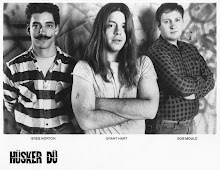
Husker Du were Bob Mould ( vocals, guitar ), Grant Hart ( vocals, drums ) and Greg Norton ( bass, moustache ) - with both Mould and Hart writing the songs..... something which would lead to friction over the years and contribute to the band's demise. They formed in Minnesota in 1979 and, as contemporaries of bands like The Minutemen and Black Flag, were initially a very fast, thrashing Punk/hardcore band. Their first ( live ) album was called Land Speed Record, which pretty much summed up their musical philosophy at the time.
Before long, however, they began to break out of the hardcore straitjacket and introduced more melody and variety to their sound. The mini-album Metal Circus pointed the way towards the "grunge" sound of the '90s ( especially on Hart's murder ballad Diane ) and the ambitious, sprawling double Zen Arcade was actually a ( whisper it! ) concept album which dabbled in psychedelia. As the band became more popular the major record labels came calling but, before their temporary step up to the big leagues, they produced one last classic for their old label, SST: New Day Rising.
It starts with a restating of their hardcore credentials: Mould and Hart shouting, screaming and howling the album title over a barrage of thunderous drums and squalls of guitar. As attention-grabbers go, it certainly works. Then we're straight into the new, poppier Husker Du sound, with Hart's The Girl Who Lived On Heaven Hill, boasting a huge, singalong chorus. Well, I say "poppier" but, by the end of the song, Hart's screaming his head off again, from up there on the top of Heaven Hill. Mould's I Apologise follows, anticipating the emo genre with its brutal dissection of a relationship going wrong.
And that's one of Husker Du's great legacies - they had moved beyond the punk cliches of earlier songs like Deadly Skies and Obnoxious and were now talking about the joy and pain of real life. Over top of some bloody loud guitars, of course. The three songs which close side one of the album ( vinyl forever! ), If I Told You, Celebrated Summer, and Perfect Example are fantastic, er, examples of the Husker Du methodology - heart-aching lyrics welded to great tunes and Bob Mould's shimmering, multi-tracked guitars.
"Do you remember when the first snowfall fell
In such a celebrated Summer?"
But just when you think it's all got too grown up and sensible, the band hit us with the bizarre discordance of How To Skin A Cat, the redneck anthem Whatcha Drinkin' and Grant Hart's piano-assisted alternative pop classic Books About UFOs. And to finish we get the almost compulsory Bob Mould guitar freak-out. On Zen Arcade the band had produced a 13-minute, experimental epic, Reoccurring Dreams; here they were less self-indulgent and Plans I Make is a mere 4 minutes of chainsaw guitars, feedback and Mould's anguished vocals.
Sadly, Husker Du imploded a couple of years later, following drug problems, creative tensions and the suicide of their manager. They'd only achieved moderate success, even after signing to Warner Brothers and seeing their last album, Warehouse: Songs And Stories, being relentlessly hyped by the music press. Mould and Hart pursued solo careers with varying success and Norton went into the restaurant business, with only the occasional return to music. They were, however, a huge influence on the next generation of alternative rock ( Pixies, Nirvana etc. ) and on such big-business "punk" bands as Green Day. ( Not to mention the legendary Death Planet Commandos. Well..... they're legendary in my house, anyway. )
Tuesday, 9 November 2010
Pet Sounds by The Beach Boys

When I was a teenage wannabe-Punk I didn't like The Beach Boys. I mean I really didn't like them. I thought the harmonies were girly, the fun-in-the-sun lyrics were too cheesy, the clothes were bloody awful, and what the Hell was Sloop John B about anyway?
Now, of course, I love The Beach Boys and I especially love Pet Sounds, the album containing - you've guessed it - Sloop John B.
Pet Sounds is famously the album where Brian Wilson took creative control of the group and steered them away from their previous surf / rock 'n' roll style towards a more symphonic, studio-based sound. And what a sound! Wilson throws in strings, Theremins, bicycle bells, clip-clop percussion, harpsichords, rasping horns and possibly a kitchen sink on a surfboard, who knows? It almost strays into the realm of the avant garde before settling for queasy-listening on a couple of strange filler instrumentals. The trademark Beach Boy vocals are present and correct and perfect, alternately joyous and heartbreaking.
As well as Sloop John B, the album also contains two of their most well-known singles, Wouldn't It Be Nice and God Only Knows, mini masterpieces of yearning and heartache. And, if not for Brian Wilson's perfectionism, the awesome Good Vibrations would have appeared here as well, instead of propping up the next album, the deeply flawed Smiley Smile.
Lyrically, Pet Sounds is a lot deeper than previous Fun Fun Fun -type material. The first track, Wouldn't It Be Nice, is a childlike wish to be grown up and married but, after that, things take a more introspective and troubled turn. The songs' protagonists often feel lonely or betrayed and offer warnings about former lovers and friends.
"I went through all kinds of changes
Took a look at myself
And said 'That's not me' "
"Where can I turn when my
Fair-weather friends cop out?
What's it all about?"
Even the traditional Caribbean folk song, Sloop John B, seemed to fit in well:
"I feel so broke up, I want to go home
This is the worst trip I've ever been on."
With hindsight all this is sadly indicative of Brian Wilson's fragile mental state, culminating in the honest admission of I Just Wasn't Made For These Times. The uncertainty and confusion in these lyrics ( along with the fantastic music ) adds a resonance to the album that elevates it to its classic status.
Song for your favourite surfer girl: Don't Talk ( Put Your Head On My Shoulder )
Tuesday, 26 October 2010
Surfer Rosa by Pixies

There are many bands that I learned to love over a long period of time, while others hit me straight between the eyes the first time I heard them. In the case of Pixies ( no "The" required ) it was an instant knock-out.
I first heard about them when they were touring the UK with the Throwing Muses in 1988 and the music magazines of the day went ballistic over them. The late, lamented Sounds gave away a free 7" single featuring the songs Down To The Well and Rock A My Soul which were quirky and spooky, especially compared to the fey indie-pop of the time, typified by the C86 scene.
I missed out on their mini-album, Come On Pilgrim, but bought Surfer Rosa and was amazed by I'm Amazed, lost my mind to Where Is My Mind? etc. etc.
Pixies' early music is a strange, dark world of weird sexuality, mutilation and swearing in Spanish. Black Francis' lyrics are visceral and Biblical, obsessed with pain and pleasure in songs such as Bone Machine, Break My Body and Broken Face, but turning strangely goofy on songs like Tony's Theme and Oh, My Golly! His vocals, now sensual, now raw and screaming, interact with Kim Deal's huskily sexy voice and forceful bass-playing, and with David Lovering's pounding drums, to create an uncertain, edgy glimpse into Pixie-world. Cutting through and underpinning all this is the wailing, moaning, grinding, dirty guitar-sound of the sadly underrated Joey Santiago ( and isn't that the coolest name ever for a guitarist? ), a six-string symphony of deviancy. The production, courtesy of the controversial Steve Albini, is suitably brutal, everything turned up to ear-lacerating volumes. The stop/start, loud/quiet dynamics ( more fully realised on the next album ) were to be a major inspiration to more commercially-successful bands like Nirvana and Smashing Pumpkins.
Pixies were to go on to more ( limited ) success with their next album, Doolittle, which had some fantastic songs ( Debaser, Monkey Gone To Heaven, Wave Of Mutilation ) and a smoother but still unconventional sound. But I'll always go back to the bruises, incest and cactus-littered landscapes of Surfer Rosa. I think I need a shower now.....
Song to play as the walls come tumbling down: Where Is My Mind?
Sunday, 17 October 2010
Psychocandy by The Jesus & Mary Chain
Feedback. Echoing drums. Big hair. More feedback. Deep voices. Guitars going "skreeeeeeeeeech!!"
And more feedback.
Yes, it's those happy Reid brothers, Jim and William, here to rescue the mid-'80s UK music scene from mediocrity and Marillion.
Unusually for me I got into The Jesus & Mary Chain from day one. Well, from single number one, anyway. I bought their debut Upside Down / Vegetable Man 7" from The Trading Post record shop in Stroud ( one of my main haunts as a teenager and, amazingly, still going today ) and was knocked out by its grinding, migraine-inducing, feedback-ridden guitar sound, doom-laden drums and droning vocals. Ever since hearing Adam & The Ants' guitarist Marco Pirroni using feedback as part of his unique sound, I'd thought it would be cool to crank up that screeching sound to the max and build songs around it. And here were these snotty young punks from Glasgow doing just that. ( Of course, I hadn't heard of the Velvet Underground at this point. ) And, as if the music wasn't great enough on its own, the band looked amazingly cool and permanently pissed-off, played controversially short gigs that often ended in "riots", and seemed to be on a mission to antagonise tabloids, other bands, the music press and their own record label. Perfection.
More brilliant ( and slightly slicker ) singles followed: the intense, angry Never Understand, the more intense and more angry You Trip Me Up, and the less angry but still intense Just Like Honey. For some reason I really thought You Trip Me Up would be a massive chart hit in the summer of 1985 - surely the UK's pop kids would hear more than just the squalls of feedback and realise what a classic pop song it was? Er, no. It actually reached the dizzy heights of no. 55 in the chart. I still remember some journalist on Radio One's Newsbeat referring to the Mary Chain's music as "feedback and not much else" at the height of their "New Sex Pistols" notoriety. Of course, that sense of dismissal would only make their fans close ranks and love them even more fiercely.
And then came the album.....
Psychocandy surely stands as one of the greatest debut albums in rock. The fact that the Mary Chain never really scaled such heights again only adds to its grandeur. The album really shouldn't work: it's a still-startling mash-up of seemingly disparate elements - the squealing white noise, the Phil Spector / girl-group drumming, the "poor me" indie vocals, and lyrics like these:
And the sun don't shine
And all the stars don't shine
And all the walls fall down
And all the fish get drowned
.....yeah, OK. In fact, the brothers Reid were/are deeply in thrall to age-old rock 'n' roll themes of disillusion, rebellion, doomed love and heartache. In these songs women are beautiful but treacherous ( You Trip Me Up, The Hardest Walk ), life is hard ( Something's Wrong, It's So Hard ) and even the rock 'n' roll dream of escaping on a big, black motorbike ( The Living End ) ends in disaster - "My head is dripping into my leather boots". Jim Reid's American-via-Glasgow vocals are full of hurt and hunger, throwing none-more-rock " Hey hey hey"'s all over the place like a Scottish Joey Ramone; while William Reid's six-string screams of feedback are more carefully-sculpted than is at first apparent, some beautiful melodies lurking beneath the waves of surging sound. Amongst all this chaos and confusion they find a dark, bleak ( not to mention pretentious ) poetry:
Love's like the mighty ocean
When it's frozen
That is your heart
or
I never thought that this day would ever come
When your words and your touch just struck me numb
And it's plain to see that it's dead
This thing's losing blood
On this cool sunny day
or that indie-disco favourite:
Listen to the girl as she takes on half the world
Moving up and so alive
In her honey-dripping beehive
No, I don't know what it all means, but it sounds fantastic, fatalistic and painfully adolescent. The whole album is a gloomy teen's dream of love and angst and anger, but it still sounds exciting and energising to this ( gulp! ) forty-something. The Mary Chain would grow up and calm down on their second album, Darklands, which produced such classic singles as April Skies and Happy When It Rains, but couldn't hold a black, patchouli-scented candle to Psychocandy.
Song to play after being stabbed through the heart by an icepick of emotion: You Trip Me Up.
Thursday, 7 October 2010
The Band by The Band

The Band's music used to be a mystery to me. And then it became a myth, or maybe a legend.....
When I was a kid I used to occasionally hear their songs, but I never knew who they were or what they were singing about. This might not be an unusual problem for a band ( or Band ) who seemed almost deliberately anonymous, whose music was in a genre all of its own, who didn't really fit in anywhere.
My first exposure to the Band's music came ( improbably enough ) from a James Last album called "Rock Me Gently - A Tribute To The Great Canadian Songwriters." This collection of easy-listening / big band versions of pop hits featured songs by R Dean Taylor, Gordon Lightfoot and one Jaime "Robbie" Robertson, composer of The Night They Drove Old Dixie Down which, in this incarnation, was a full-on faux-Nashville singalong that sounded like a Tammy Wynette cast-off. So, my parents' album of middle-of-the-road German dance-band music introduced me to what would, much later, become one of my favourite songs of all time.
Years later, Radio One's Mr. Cheese, Simon Bates, would often play Band songs on his oldies show, the Golden Hour. I became aware of classics such as Rag Mama Rag, The Weight and Rockin' Chair, although I didn't know who was behind them. I can remember listening to The Night They Drove Old Dixie Down and being puzzled by the song: what was it all about? why are the people singing and the bells ringing when the singer sounds so sad? and what is a Dixie anyway? The mystery continued.....
Even more years later I bought my wife Sarah a Summer Of Love-type '60s compilation tape for her birthday ( yep, an actual cassette - it was a while ago..... ) and amongst all the usual suspects - Byrds, Mamas and Papas, Donovan, Jefferson Airplane etc. - there was a strange little song called The Weight by a band called..... er, The Band. I sort of remembered it from years ago but I'd never really listened to it before. The haunting guitar intro, the ragged but beautiful harmonies, the mysterious lyric: all these seeped into my brain and I became hooked on the song, had to keep rewinding and playing it again. There had to be more. I learnt from magazines like Mojo and Uncut that The Band, those four Canadians and one Arkansas boy, had been a former backing band to small-time rockabilly legend Ronnie Hawkins, before going on to back Bob Dylan during his "going electric" period, retreating to a basement to write their own songs, and finally emerging as artists in their own right with Music From Big Pink, one of the most celebrated debut albums of all time. I caught a late night showing of The Last Waltz, the Martin Scorsese-directed film of the group's last gig ( trust me to do things arse-backwards ) and was knocked out by the songs, the atmosphere, the dynamics, the fantastic vocals of Richard Manuel, Levon Helm and Rick Danko. Surely it was now time to actually buy some of this stuff!
The Band by The Band, the so-called "Brown Album", the cover a sepia-tinted photo of five grizzled, pissed-off guys ( farmers? prospectors? bandits? ) standing in the rain in some forgotten, backwoods corner of America. The songs themselves are hazy, faded snapshots of half-remembered lives and loves; a whole cast of characters, maybe all living in the same dirt-poor town at the end of a lonesome trail, all with tales to tell. The jittery lover asking his girl where she's hidden her gun, the farmer praying for a good harvest, the unrepentant thief, the two old sailors dreaming of a life ashore, the good-time girl who lives to dance, the young Confederate soldier recounting the fall of the South.....
All of these characters and stories are brought to life by The Band's warm, organic, rootsy style: a rich stew of country, r 'n' b, soul, gospel and funk, with a dash of rock 'n' roll. Fiddles, horns and keyboards add colour and texture; lines are traded between the three ( wonderful ) singers; instruments are swapped around to suit the song, not the performers' egos; traditional rock 'n' roll excesses are curbed - the song is everything.
The Band brought a new perspective to rock 'n' roll ( although some would say a conservative one ) - when everyone else was turning on, tuning in and dropping out, they were reaching into the past for a feeling of community, history and shared experience. A song like The Night They Drove Old Dixie Down was something unprecedented at the time: a lament for a lost way of life and for a people that had fought for the "wrong" side and paid the price. Even up-tempo, rocking songs like Up On Cripple Creek and Jemima Surrender still somehow had that "old-fashioned" sound that led to the record being referred to as "the best rock 'n' roll album of the nineteenth century."
The beauty and strangeness of The Band's "old, weird America" stays with you and becomes a part of your own interior landscape, a window on another world. And that's no mystery.
Song to whistle down a country lane: King Harvest Has Surely Come
Saturday, 25 September 2010
Born To Run by Bruce Springsteen

"The album became a monster. It wanted everything. It just ate up everyone's life."
That's Bruce Springsteen talking about Born To Run, the album that made his name, that saved his career, that became a classic. It also drove him to the brink of despair and broke up his band. Phew! Rock 'n' roll, eh?
After the relative failure of his first two albums and the impossible pressure of living up to Jon Landau's "future of rock 'n' roll" tag, Springsteen knew his third album was make or break time. He knew that he had to simplify his overly-wordy songwriting and his jazzy/funky/folky music; he had to reduce it all down and find the essence of rock 'n' roll, the total of all his early influences - Elvis/Roy Orbison/Gary "U.S." Bonds, British Invasion bands, Phil Spector - while mostly ditching the folk/Dylan influence of the early 70's.
Over a tortuous year of recording Springsteen marshalled his band and hammered away at his songs, rewriting, refining, recording take after take, all in his quest for perfection. Original E Street Band members David Sancious and "Boom" Carter bailed, the record company got jittery, the studio's piano would frequently go out of tune, one master tape was recorded so badly that Bruce threw it out of his hotel room into a river. And so it went on.
Eventually, something emerged.....
Mean Streets with guitars, West Side Story with a pulsating rock 'n' roll soundtrack, Born To Run is a wild, midnight ride into the dark side of the American Dream, where street punks and beautiful girls drink warm beer in the soft summer rain, hold each other tightly in the darkness and plan their escape. They don't know what they're escaping to, but anything's gotta be better than this "rat trap", right?
Springsteen has remarked that his first two albums had a real sense of place, whereas Born To Run "is about being nowhere at all." Images of escaping and finding yourself abound:
Well the night's busting open / These two lanes will take us anywhere
It's a town full of losers / I'm pulling out of here to win
and, of course:
We've gotta get out while we're young
'Cos tramps like us, baby we were born to run
It's all romantic as hell, as well as terminally naive. This was the last chance for such hoary old rock 'n' roll notions; Springsteen had grown up on rock 'n' roll and was able to reinvigorate its familiar themes, but after him the road led to the overblown pastiche of Meatloaf, which was fun but empty. But here, on the mean streets of Anytown, USA, we're plunged into Springsteen's rock opera mix of R 'n' B , Duane Eddy guitar, deep canyons of reverb, plaintive sax and rippling piano, all giving the music an authority and an atmosphere that's built to last, chrome wheeled and fuel injected.
It's hard to single out individual songs for praise: the album is so well-structured that you don't want to pick it apart for fear the whole edifice might crumble. From the beautiful piano 'n' harmonica intro of Thunder Road, through the good-time sway of Tenth Avenue Freeze Out, the tension/release of Backstreets, the low-key trumpet-and-tenement-tale of Meeting Across The River, and on to Bruce's final, wordless cries on the awesome Jungleland, the album is a masterclass in classic rock moves or, in Greil Marcus' words "a '57 Chevy running on melted-down Crystals records."
On a personal note, when I first bought Born To Run, on second-hand vinyl for a couple of quid, I was going through quite a tough time. I'd been off work for months with the double-whammy of a back injury and redundancy, and was feeling pretty low. As those who really love music will understand, there's little more therapeutic than some good, old-fashioned rock 'n' roll, and Born To Run was good medicine. Cheers, Bruce!
Outside the street's on fire in a real death waltz
Between what's flesh and what's fantasy
And the poets down here don't write nothing at all
They just stand back and let it all be
Greatest Rock Sax Solo Of All Time: Clarence "Big Man" Clemons, Jungleland
Wednesday, 22 September 2010
London Calling by The Clash

London Calling? London bloody Calling? Isn't that the most obvious, put-no-thought-into-it, predictable Clash album of all? The one that everybody lists as their favourite, usually when it's the only one they've heard? Well, yes and no.....
( Don't you just hate it when people say that? )
When I was compiling my 15 albums in 15 minutes list, I have to admit that London Calling was the first Clash album to pop into my head, so, by my hard and fast rules ( not very Punk! ), it had to go in.
I could have chosen debut album The Clash, for its kick-down-the-doors, sulphate-fuelled rush of energy, attitude and anthems. Or I could have chosen Combat Rock for the more sophisticated but still essential and angry Clash it presented - as well as for being home to the haunting Straight To Hell. But London Calling it had to be - mainly because it's the Clash album I play the most. But that wasn't always the case.....
When I first bought the album and got past the iconic sleeve art and the apocalyptic title track my first impression was bemusement. If these guys are punks why are they singing some old rock 'n' roll song about Cadillacs? And where's that 1-2-3-4 no-nonsense all-purpose *Punk* sound? These songs are funky and even ( whisper it... ) jazzy! About the only songs to replicate the "old" Clash sound were London Calling itself and Clampdown. It made me scratch my head for a long time, but then the penny dropped: the Clash have graduated. They've left the old Punk Rock ghetto behind and stepped out onto a bigger stage, a world stage. And they're daring you to go with them.
"In every dingy basement on every dingy street
Every dragging handclap over every dragging beat
They're just the beat of time, the beat that must go on
If you've been trying for years - we've already heard your song"
The Clash set their sights higher than just providing the soundtrack for another night's glue-sniffing down the 100 Club. London Calling is a huge ( 4 sides of vinyl back in the day ), sprawling, technicolor explosion of styles, influences and new directions. After tentative stabs at reggae on previous tracks the band now step up their game and hit us with ska, soul, lover's rock, dub, Phil Spector-esque epics, splashes of jazz and funk and even disco, that enemy of all narrow-minded rockers. But all these styles are filtered through the band's unique sensibilty - you know it's still The Clash, but a fearless, forward-thinking Clash. The songs are populated by punks, lovers, dealers, hustlers, movie stars, suits and gangsters. And what songs! They burst at the seams with tunes, hooks, melodies and lyrics of both the thought-provoking and grin-inducing kind. Every band member is at the top of their game, with a special mention for Topper Headon, freed from Punk restrictions to show us what a supremely talented and funky drummer he is. It all ends with the classic hit single The Clash never had, Mick Jones' wonderful Train In Vain. ( Just don't mention the godawful Annie Lennox cover version! )
So, yeah..... London Calling, the predictable choice. The right choice.
Soundtrack to the dawn of the 80's: Revolution Rock
Subscribe to:
Posts (Atom)